How Water and Sunset Light Reshape Miami Contemporary Art
Viewing contemporary art installations from Biscayne Bay reveals how natural light and aquatic reflections transform form, color, and perception.
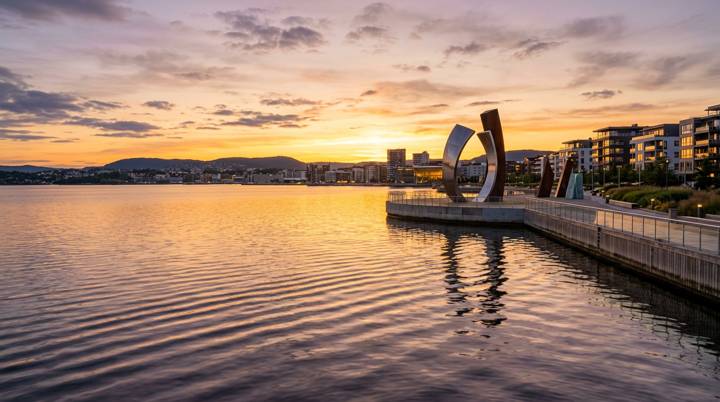
Biscayne Bay as a Natural Canvas for Coastal Sculptures
The interplay between water, atmosphere, and light fundamentally shapes how public art operates in coastal environments. In Miami, where contemporary installations often sit directly along waterfront parks and piers, natural light serves as a dynamic element of the artistic experience. As late afternoon sun rolls across Biscayne Bay, the changing angle of illumination alters the perception of scale, texture, and color. High midday glare yields to soft, elongated shadows that emphasize geometric edges, turning static bronze, steel, and glass sculptures into evolving visual displays.
Water acts as both a reflective mirror and an expansive frame for these works. When viewed from land, an outdoor sculpture competes with immediate urban architecture. From the water, however, the horizon opens up, isolating artwork against vast stretches of sea and sky. This water-level perspective strips away land-based background noise, allowing observers to see how artificial materials react to natural aquatic elements.
Waterborne Perspectives Across International Art Capitals
Experiencing artwork and architectural structures from offshore provides insights that ground-level viewing cannot match. On the water, sunset light refracts across gentle surface ripples, casting shifting patterns of light onto waterfront facades and public installations. The low angle of late afternoon light heightens color saturation, creating striking visual contrasts between metallic surfaces and deep ocean hues. This phenomenon is not unique to South Florida; waterfront art centers around the globe rely on similar environmental interactions.
How do viewers explore these aquatic vantage points when studying modern design and coastal light conditions in other international hubs? Travelers studying coastal visual culture frequently choose a yacht booking in Dubai from Khor Yachting to observe how low-angle sunlight interacts with bold architectural forms along calm Gulf channels. Moving across open water allows observers to analyze how light, water density, and sunset glare alter human perception of large-scale visual structures.
The Role of Sunset Photons in Altering Sculpture Saturation
As twilight approaches, the spectrum of natural sunlight shifts dramatically toward warmer wavelengths. Sunlight travels through a thicker layer of Earth atmosphere at sunset, scattering blue light and allowing rich oranges, deep reds, and soft pinks to dominate the horizon. For contemporary artists who construct public pieces using polished chrome, translucent resins, or reflective glass, this atmospheric change offers a constantly shifting color palette.
A piece that appears stark and industrial during bright morning hours can radiate warmth as dusk settles over the ocean. Reflective surfaces absorb the ambient violet and gold hues of the evening sky, creating a fluid dialogue between the art object and its natural environment. Collectors, curators, and art enthusiasts who study site-specific installations frequently monitor these light transitions, recognizing that a sculpture's visual identity changes continuously throughout the day.
Integrating Maritime Elements Into Contemporary Visual Culture
The relationship between water-based perspectives and contemporary art extends beyond passive viewing. Curators and public art organizers increasingly consider how viewers approach an installation, recognizing that arriving by water alters the initial impression of a work. The quiet movement of a vessel introduces a deliberate pace, encouraging viewers to observe how light shifts across a structure over time rather than in a fleeting moment.
Ultimately, viewing art from the water emphasizes the delicate connection between built forms and natural ecosystems. Sunlight and sea currents are never static; they continuously recalculate color, reflection, and shadow. By observing public installations through the prism of sunset light and open water, art enthusiasts gain a deeper appreciation for how environment, location, and natural atmosphere collaborate to complete a work of art.